Before buying a used car, read the date code on each tyre and inspect its tread, sidewalls and wear pattern. The four-digit manufacture code can tell you how old a tyre is. Its age is one useful clue, but it cannot tell you whether the tyre is safe on its own. Condition, pressure, previous damage and the vehicle’s maintenance all matter.
How do you read a tyre date code?
Look on the sidewall for a group of four digits, often at the end of a longer DOT marking. The first two digits give the week of manufacture and the final two give the year. For example, 3522 means week 35 of 2022. This is a manufacture date, not the date the tyre was fitted to the car.
The code may be on the side of the tyre facing inwards, so you might not be able to read every tyre while the car is parked. A tyre specialist can help check an awkwardly positioned marking. Do not assume that four matching-looking tyres were made at the same time: inspect each one.
Is there a legal maximum tyre age for a normal car?
There is no blanket ten-year tyre-age ban for ordinary private cars in the UK. The specific ten-year prohibition applies to certain goods and passenger vehicles and axle positions. The Highway Code’s maintenance annex sets out that distinction.
An old tyre can nevertheless be a reason to ask for a professional inspection or replacement before the deal. Sunlight, standing unused, incorrect pressures, damage and previous repairs can all affect condition. A date code should prompt questions, not become a pass or fail certificate on its own.
What should you check besides tyre age?
Tread depth and even wear
For an ordinary car, the legal minimum is 1.6mm across the central three-quarters of the tread around the entire circumference. Check several positions around each tyre with an appropriate tread gauge. The GOV.UK roadworthiness guide confirms the minimum. A tyre only just meeting the legal limit may still have limited useful life left, which affects what the car is worth to you.
Uneven inner-edge wear, one shoulder wearing faster than the other or unusual wear on a single wheel can point to incorrect pressure, wheel alignment or another issue. It deserves an inspection rather than a guess about the cause.
Sidewalls, cuts and bulges
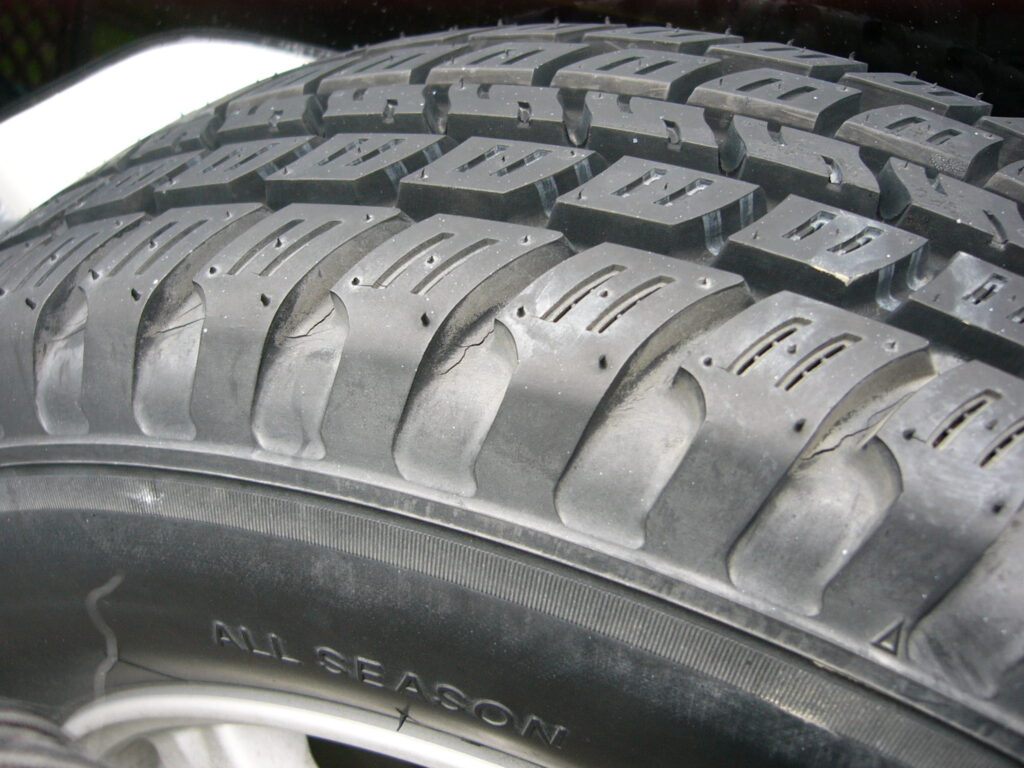
Look for cracks, cuts, lumps, bulges or exposed material. These can matter more than the date stamp. The DVSA MOT inspection manual explains the tyre defects an MOT tester examines. If a tyre looks damaged, do not rely on the seller’s reassurance. Get it examined by a qualified tyre professional.
Tyre matching and spare wheel
Compare the sizes and markings on the two tyres on each axle. Check that the wheels have suitable tyres for the vehicle and look at the spare or inflation kit where fitted. Ask why a car has one very new tyre and three older ones, particularly if a wheel or suspension repair is mentioned in the advert.
Can the MOT history tell you whether the tyres are good?
The official MOT history service can show previous failures and advisories, including recorded tyre wear and defects. It is useful for spotting patterns over several tests. An MOT records the condition on the test date and does not guarantee the tyres’ condition today. A recent pass should be considered alongside what you can inspect at the viewing.
Compare the recorded MOT mileage with the advert and ask about unusually rapid tyre wear. Keep maintenance receipts and replacement invoices alongside the service record when judging a car’s history.
What should you ask the seller before paying?
- When were the tyres fitted and is there a receipt?
- Have the wheels needed alignment or suspension work?
- Were any recent MOT tyre advisories repaired?
- Can you inspect the inner sidewalls and tread before committing?
- If tyres need replacing, has that cost been reflected in the asking price?
Tyres are part of the buying calculation. So are the vehicle’s recorded mileage, MOT history, identity and previous history. Start with a Rapid Car Check by registration before travelling and compare the records with the physical car and its paperwork.
A vehicle history check cannot establish tyre or mechanical condition. Inspect the car carefully and arrange an independent mechanical assessment when the condition or asking price warrants it.